
 Русский
 සිංහල
 Deutsch
 Français
 Nederlands
 Italiano
 Español
 简体中文
A Landscape of Myth and Memory
The mountains around Ella have long been associated with stories connected to King Ravana and the Ramayana tradition. Ravana Ella, Ravana Cave and several other locations in the region have become part of a wider landscape of mythology in which caves, waterfalls and mountains are linked to the legendary kingdom of Ravana.
Nil Diya Pokuna eventually became part of that tradition as well.
According to a local legend, Ravana brought Sita to the underground chamber and used the hidden pool as a private bathing place for himself and his queens. Some versions of the story also connect the underground passages with other locations associated with the Ravana tradition.
There is no archaeological or historical evidence proving that Ravana used Nil Diya Pokuna, or that the underground network was created during the period described in the Ramayana stories. These accounts belong to local mythology and oral tradition.
That distinction makes the place even more interesting. Sri Lanka has many landscapes where history and mythology exist side by side, and Nil Diya Pokuna is one of the clearest examples of how a natural environment can become part of a much larger cultural story.
When the Forest Gives Way to Rock
From the outside, there is little to suggest what exists below the forest.
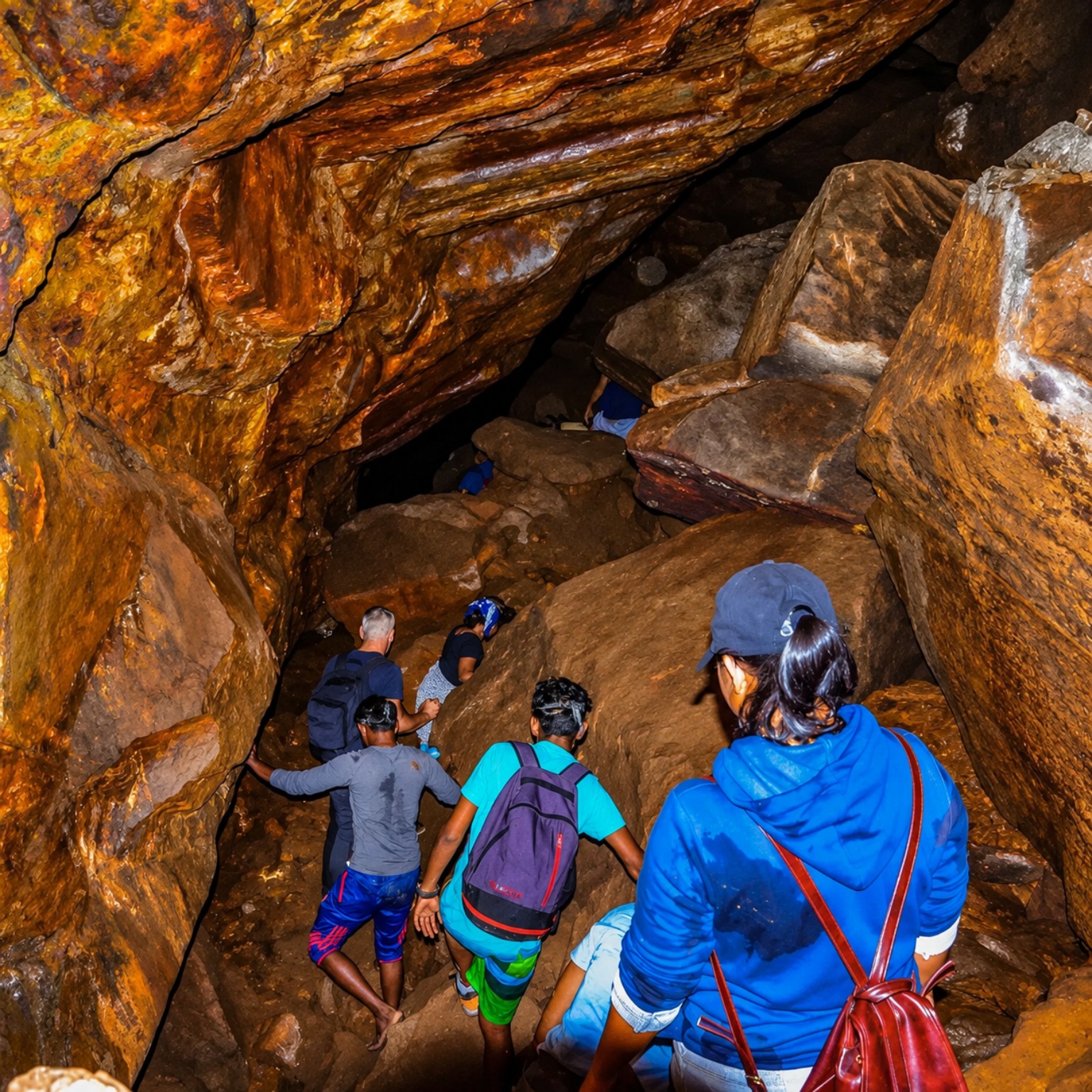
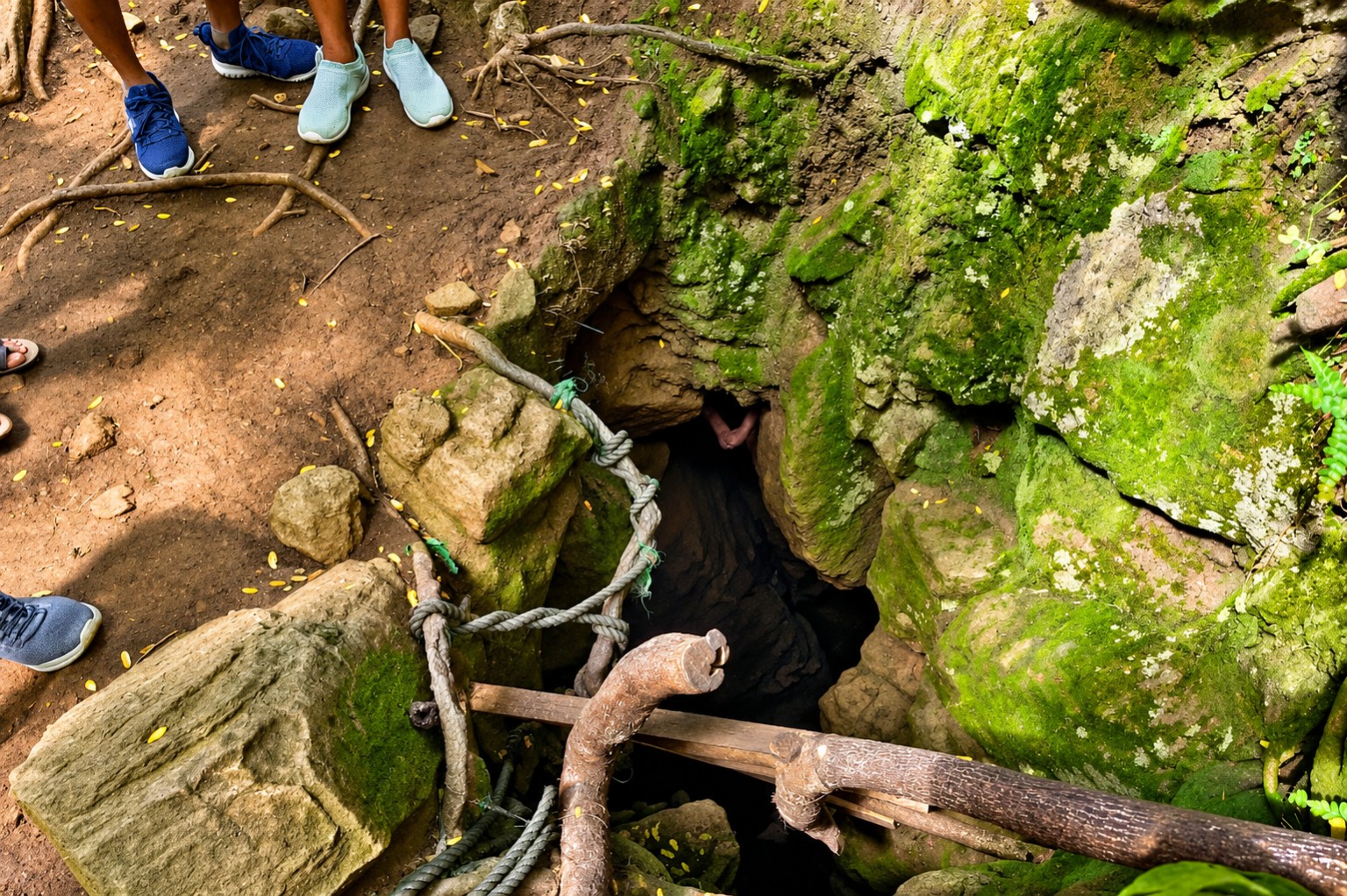
The entrance is reached through the rugged landscape around Karandagolla, where the journey gradually moves away from ordinary roads and into the forest. The descent is not comparable to visiting a conventional tourist attraction. Narrow passages, uneven rock, ropes, ladders and steep sections form part of the experience, and the underground environment requires careful movement.
As you descend farther into the mountain, natural light becomes increasingly distant. The temperature changes, the sound of the forest disappears, and the surrounding rock begins to dominate the experience. The journey itself becomes an important part of understanding Nil Diya Pokuna because the underground chamber is not simply something you arrive at; it is something you gradually discover.
Eventually, the passage opens into a much larger underground space.
And somewhere within that darkness is the blue water that gave the place its name.
Exploration Opens Another Chapter
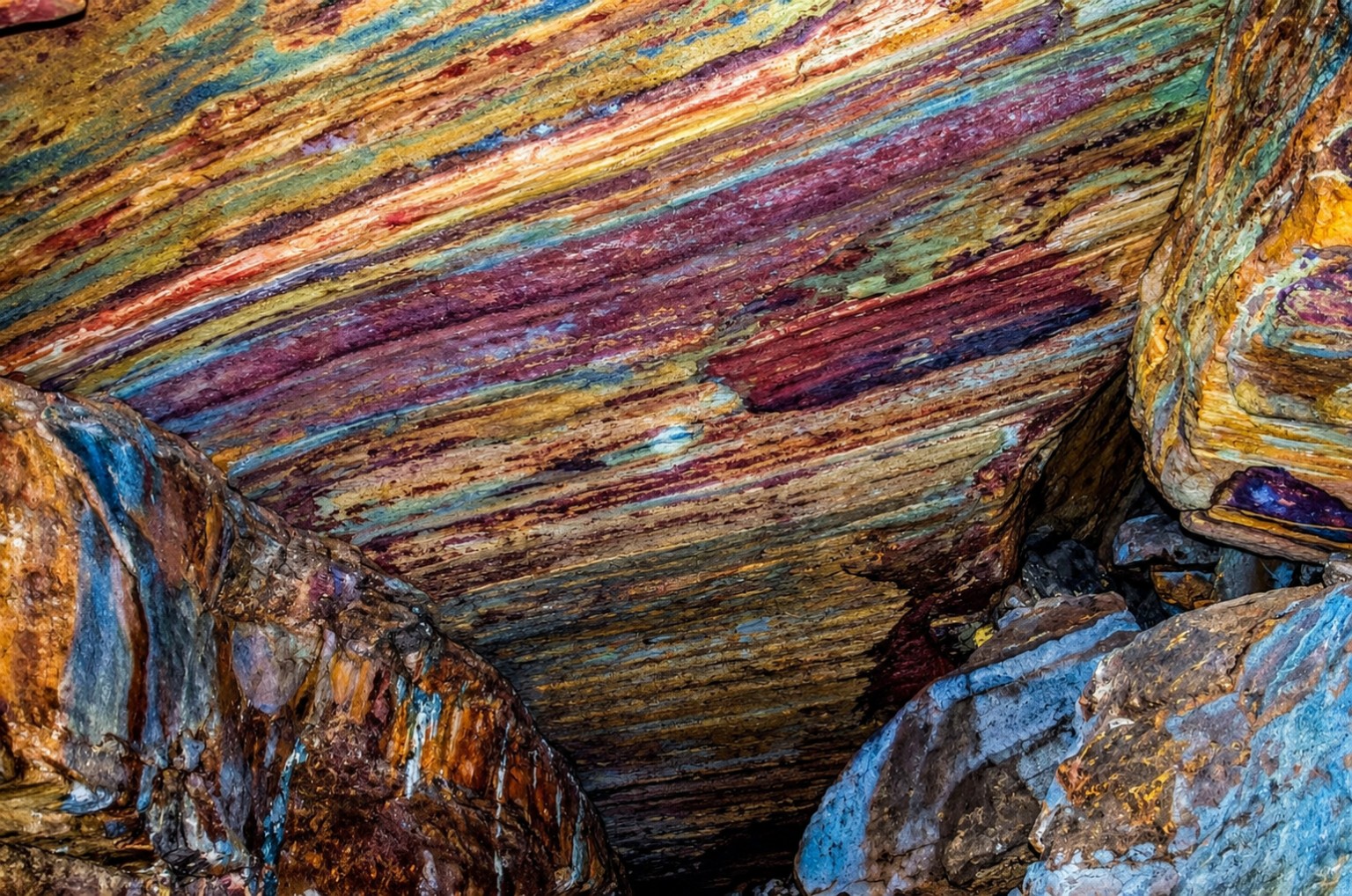
Although local people knew of the existence of the underground site, Nil Diya Pokuna became much more widely known during exploration of the cave system in the early 2000s. Accounts of its rediscovery vary in their exact dates and details, but the site gradually attracted greater attention as explorers began examining the underground chambers and passages.
One important part of that exploration involved R. M. Meththananda, who identified another entrance into the underground system. Later, technical divers began investigating the water-filled sections that had previously remained largely inaccessible.
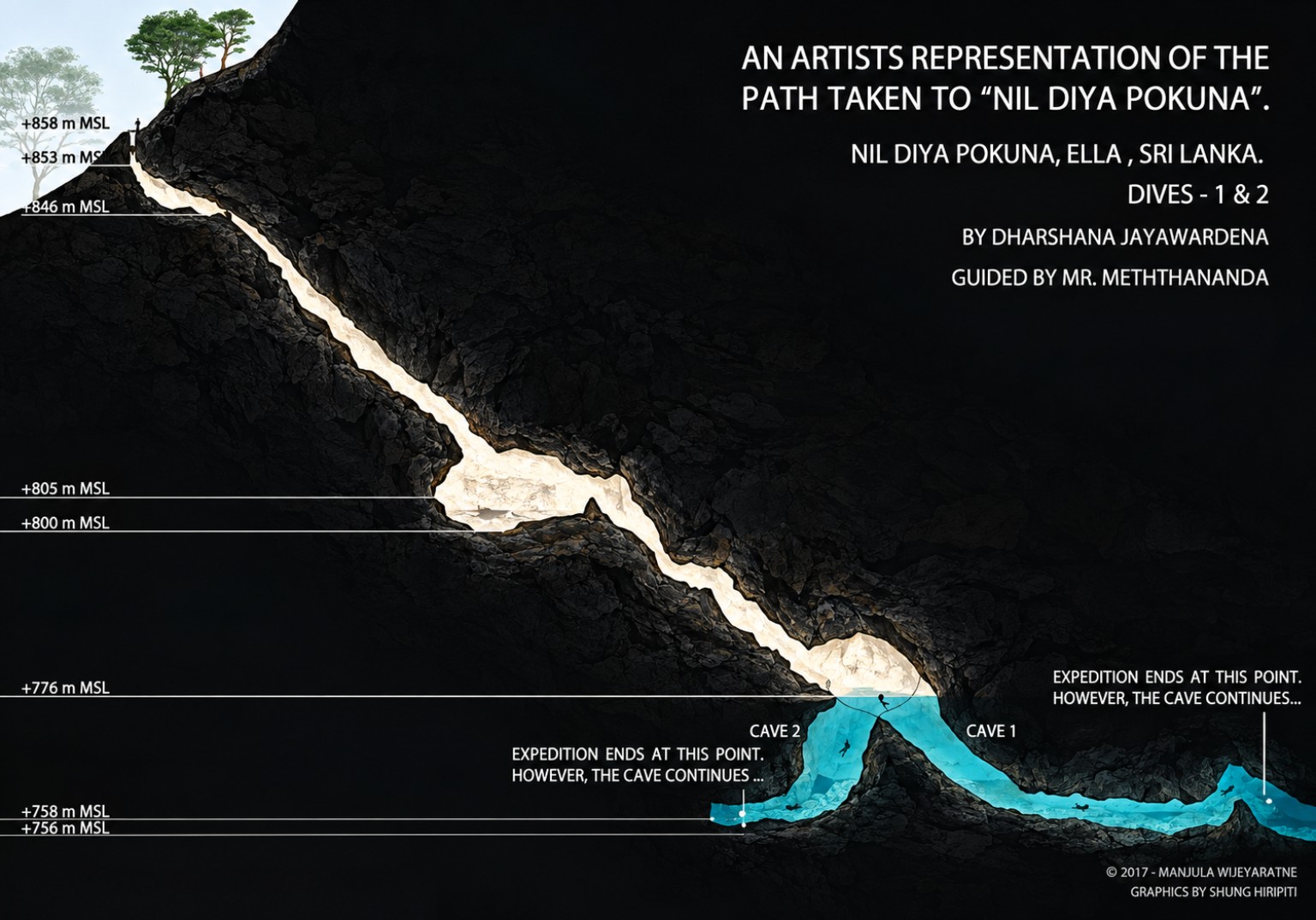
In 2017, diver Dharshana Jayawardena and other members of the exploration team carried out underwater investigations that revealed that the pool was not simply a small underground pond. Beneath the visible surface was a much more complex environment containing submerged passages and chambers.
Exploration reports described a major underground chamber measuring approximately 75 metres in length, 72 metres in width and 16 metres in height. Those dimensions give some idea of the scale of the cavern: this is not merely a narrow cave surrounding a pool, but a substantial underground space formed within the mountain.
The discovery changed the way Nil Diya Pokuna was understood. What had once been regarded mainly as a mysterious hidden pool became a significant underground exploration site with geological and scientific interest of its own.
The Pond Is Only the Beginning
The most mysterious part of Nil Diya Pokuna is naturally the water itself.
The pond lies deep inside the mountain, and early exploration estimated the underground water body to be around 80 metres from the surface. Technical diving later revealed that the water continues into submerged sections of the cave, creating an underwater environment that cannot be understood simply by looking at the pool from the edge.
Further exploration and mapping have shown that the underground system contains connected passages and changing water levels. During periods of heavy rainfall, the amount of water inside the cave can increase significantly, demonstrating that the underground environment remains closely connected with the surrounding mountain and its water system.
This is also why the cave should not be treated like an ordinary swimming location.
The blue surface that first attracts attention is therefore only one part of a much larger underground system.
The Landscape Above Becomes Invisible
Reaching Nil Diya Pokuna is an experience that demands more than simply arriving at a viewpoint.
The route begins around Karandagolla, roughly 13 kilometres from Ella, before continuing through forest terrain toward the cave entrance. The final approach involves a descent into the mountain, with narrow sections and uneven surfaces requiring care and appropriate guidance.
The exact difficulty can vary according to weather and conditions inside the cave. Rain is particularly important because underground water levels can change, surfaces can become slippery and certain sections can become more challenging.
Once inside, the environment becomes almost completely different from the landscape outside. The forest canopy, sunlight and surrounding hills disappear from view, replaced by rock formations, darkness, echoes and the sound of underground water.
The scale of the main chamber is difficult to appreciate from photographs alone. Standing inside a space that extends deep beneath the mountain creates a completely different understanding of the landscape above. The hills around Ella are no longer simply mountains covered with trees and tea. They become enormous geological structures containing hidden spaces that have remained largely invisible to the people passing across their surface.
The Moment the Mountain Reveals Its Secret
After the darkness and narrow passages, reaching the main chamber creates the defining moment of the journey.
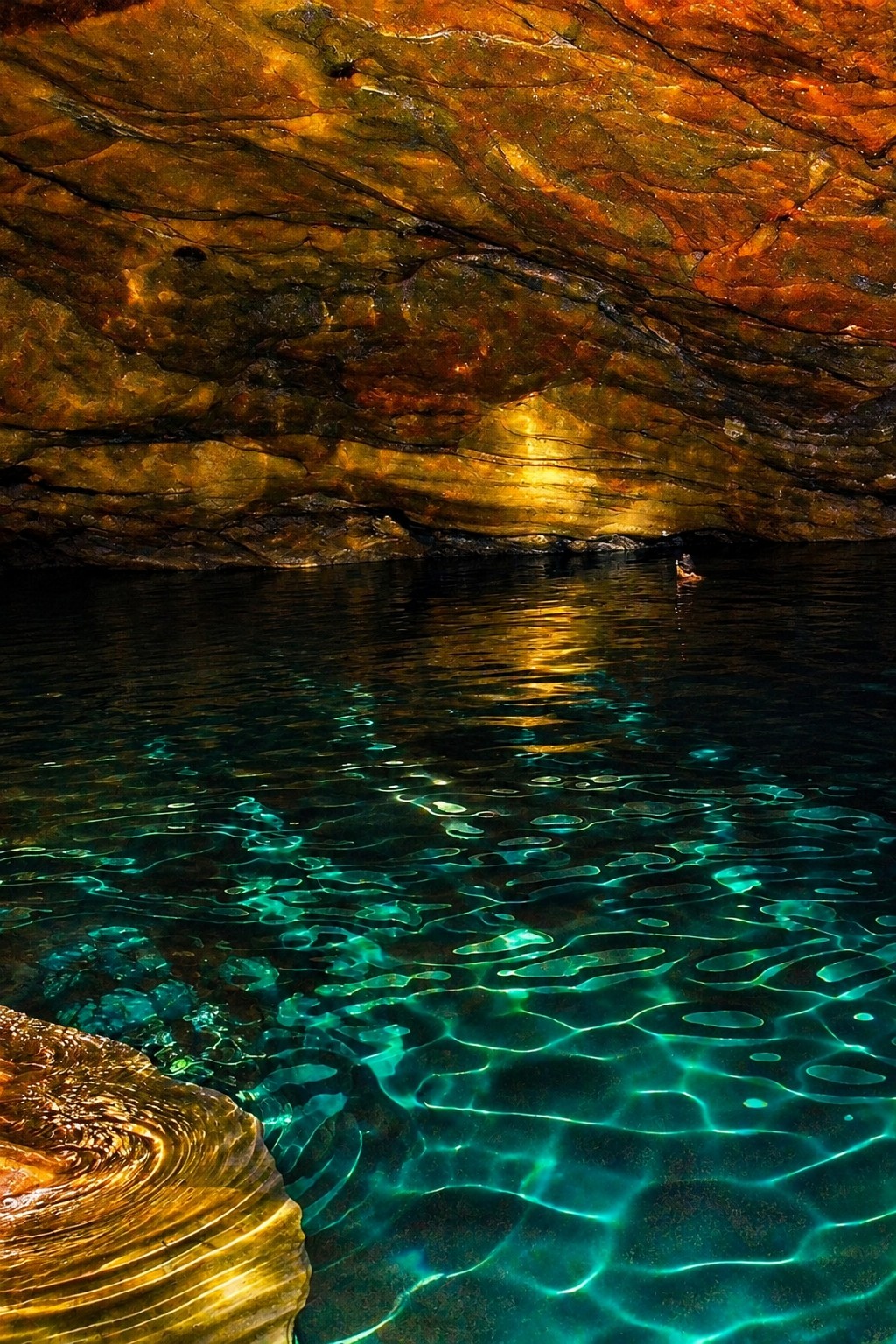
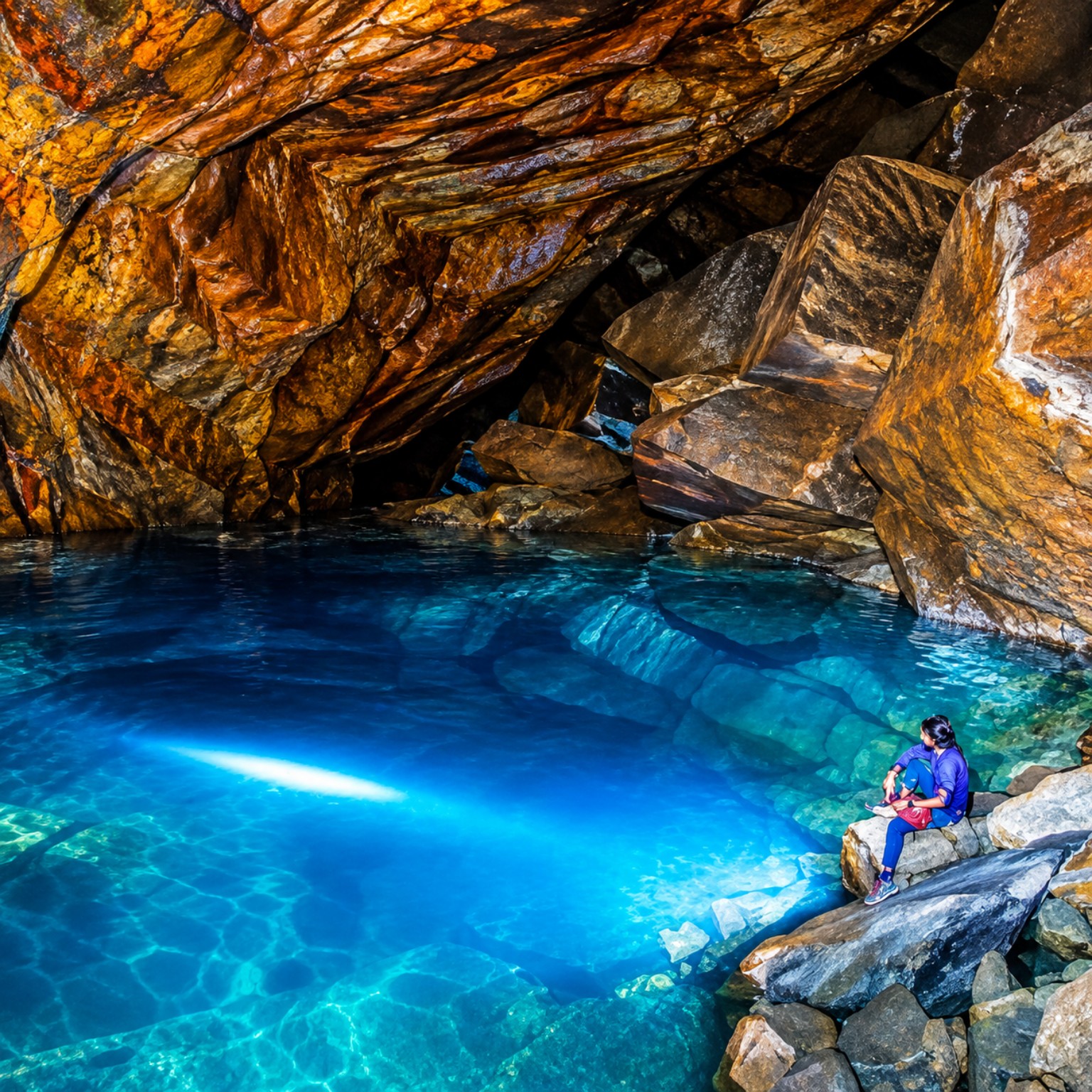
The water of Nil Diya Pokuna appears deep inside the cavern, surrounded by rock and almost completely separated from the world outside. The unusual blue appearance of the pool, combined with the darkness of the chamber, is what has given the site much of its visual identity.
But the atmosphere is not created by the colour of the water alone.
It comes from the contrast between the ordinary world above and the hidden environment below. Only a short distance away, the hills around Ella may be filled with roads, villages, tea plantations and tourists. Yet inside the mountain, those familiar surroundings seem impossibly distant.
This contrast is one of the reasons Nil Diya Pokuna feels different from many of Sri Lanka's better-known attractions. A waterfall can be seen from a trail. A mountain can be climbed. A historic temple can be entered through its main doorway. Here, the attraction is hidden behind the landscape itself.
You have to cross the forest, find the entrance and descend before the mountain finally reveals what it has been hiding.
Where Exploration and Mythology Meet
Exploration of Nil Diya Pokuna has continued beyond the first discoveries. Divers and cave explorers have mapped sections of the underground system and investigated submerged passages that cannot be reached safely without specialist equipment.
Some modern exploration reports have given names such as Ravana Maga, Sita Maga and Rama Maga to sections of the cave system. These names should be understood as names used by modern explorers in connection with the Ramayana-inspired character of the site; they are not evidence that the passages were historically created or used by the figures of the epic tradition.
The modern exploration of the cave is a real and documented process, while many of the stories attached to the cave belong to mythology and local tradition. Both have become part of the site's identity, but they should not be confused with one another.
The scientific and exploratory discoveries are fascinating enough on their own. The legends simply add another layer to a place that was already extraordinary before the stories became attached to it.
A Mythical Landscape Around Ella
The connection between Nil Diya Pokuna and Ravana is one of the reasons the site has captured the imagination of visitors.
The wider Ella region contains numerous places associated with the Ravana tradition, including Ravana Falls and Ravana Cave. Over generations, stories have connected these locations into a larger mythical landscape, suggesting that the mountains around Ella were once part of Ravana's kingdom.
Nil Diya Pokuna has been incorporated into that tradition through stories about Sita, Ravana and hidden underground passages.
There is no established historical evidence that confirms these stories, and the Ramayana itself is an ancient epic tradition rather than a modern historical record. The Ravana connection is therefore best presented as mythology and local cultural tradition, not as proven history.
Yet dismissing the legends entirely would also miss an important part of Sri Lanka's cultural landscape. Stories survive because communities continue to tell them, adapt them and attach them to places. Whether a visitor approaches Nil Diya Pokuna from the perspective of geology, adventure, history or mythology, the legends have become inseparable from the way the region is imagined.
Why a Hidden Place Needs Protection
The growing popularity of Nil Diya Pokuna has created a challenge that many hidden natural attractions eventually face.
A place that remained relatively inaccessible for generations can change quickly once large numbers of visitors begin arriving. Underground caves are particularly sensitive because their environment is difficult to restore once damaged. Water quality, rock formations, vegetation, wildlife and the physical structure of the cave can all be affected by uncontrolled tourism.
For this reason, access to Nil Diya Pokuna has increasingly moved toward a regulated model.
Sri Lankan authorities introduced specific regulations in 2026 for visitor access to the site within the Ravana Ella Sanctuary, with an emphasis on conservation, safety and controlled tourism. Access is managed through official arrangements and ticketing, while environmental requirements and visitor controls are intended to reduce damage to the underground environment. Access may also be temporarily closed because of weather, safety, conservation or other local conditions, so visitors should check the current arrangements before travelling.
These rules may make the experience more controlled than it was in the past, but that is precisely what a fragile underground environment requires.
The objective should not be to turn Nil Diya Pokuna into another crowded attraction. Its value lies partly in the fact that it remains an unusual and carefully protected natural environment.
Leave the Mountain Almost as You Found It
There is a temptation with places like Nil Diya Pokuna to focus only on the mystery. The hidden entrance, the blue water, the underground chambers and the Ravana stories all make an excellent adventure narrative, but the real importance of the site goes deeper.
The cave is part of a natural system that has developed over a very long period. Its underground water, rock formations and connected passages exist as part of the surrounding mountain environment. Once damaged, some of these features cannot simply be repaired.
Responsible tourism therefore becomes part of the story.
The best way to experience a hidden place is not to leave evidence that you were there. It is to leave the place almost exactly as you found it, so that people can continue to experience the same sense of discovery in the future.
It Is a Place You Enter, Not Simply See
One of the reasons Nil Diya Pokuna stands apart from ordinary sightseeing is that the destination does not come immediately.
The journey through the forest creates anticipation, while the descent into the mountain gradually removes you from the familiar world outside. By the time you reach the underground chamber, you have already experienced a transformation in the landscape around you.
It is a place to enter.
The experience begins long before the blue water appears. It is found in the forest path, the changing terrain, the first sight of the cave entrance, the descent into darkness and the realization that an enormous space is hidden beneath the mountain.
For travellers who enjoy adventure and places that feel genuinely different from the standard Sri Lankan sightseeing route, that journey is part of the attraction itself.
Two Sides of the Same Mountain Landscape
The experience can also be placed within the wider landscape of the Ravana Ella area.
Ravana Falls is one of the most recognizable waterfalls around Ella and has its own collection of local legends connected with the Ravana tradition. Seeing the waterfall after visiting the underground world creates an interesting contrast: one is a landscape shaped by falling water and open sky, while the other is a hidden environment buried inside the mountain.
Together, they reveal two completely different sides of the same region.
Above the ground are forests, waterfalls, roads and mountains that thousands of travellers can see. Below the surface are chambers, water passages and geological formations that very few people ever encounter.
This is what makes the wider Ravana Ella landscape so compelling. The stories are not confined to a single monument. They are woven into the mountains, caves and waterfalls themselves.
What Lies Beyond the Surface
For a long time, Nil Diya Pokuna existed largely outside the normal routes of Sri Lankan tourism. It was known through local knowledge, stories and exploration, while the wider travelling world knew little about what existed inside the mountain.
Modern exploration changed that. Divers entered the underground water system, explorers mapped sections of the cave and scientists and authorities began paying greater attention to the environment. At the same time, the old legends surrounding Ravana and Sita continued to give the place a cultural identity that goes far beyond its physical dimensions.
Today, Nil Diya Pokuna represents an unusual meeting point between mythology, exploration, geology and living landscape. The legends cannot be presented as proven history, but neither can they be separated from the cultural story that surrounds the region. The discoveries beneath the mountain are real, while the stories attached to them belong to generations of imagination and tradition.
Perhaps that is what makes the place worth experiencing.
The Story Continues Beyond the Surface
Sri Lanka is often introduced through its famous beaches, ancient cities, tea plantations, wildlife and mountains. But places such as Nil Diya Pokuna reveal another side of the island — one that cannot be understood simply by looking at a photograph or standing beside a road.
To reach it, you have to leave the surface behind and enter the mountain itself.
And when you eventually return to daylight, the landscape around Ella may look different. The same forests and mountains will still be there, but you will know that beneath them are spaces most travellers never see, shaped by nature and surrounded by stories that have travelled through generations.
Nil Diya Pokuna is not simply a blue pool hidden inside a cave. It is a reminder that Sri Lanka still contains places where discovery remains part of the journey — where the landscape has its own secrets, where mythology continues to live alongside modern exploration, and where the most memorable experiences can begin by looking beyond what is visible.
For the traveller willing to go deeper, this is not just another place to visit around Ella.
It is a journey into a hidden part of Sri Lanka that you can only understand after you have entered the mountain yourself.