 Русский
 සිංහල
 Deutsch
 Français
 Nederlands
 Italiano
 Español
 简体中文
One Island,
Many Worlds.
A journey through the nature, history, spirituality, culture and people of Sri Lanka.
One island. Many landscapes. Many traditions. Thousands of years of stories.
There are countries you visit. And then there are places you slowly discover.
Sri Lanka is one of them.
A small island in the Indian Ocean, Sri Lanka brings together mist-covered mountains, ancient cities, tropical rainforests, tea country, wildlife-filled national parks, long beaches, fishing villages, bustling towns and quiet roads within a remarkably compact landscape.
But Sri Lanka is more than its scenery.
01 — Sri Lanka at a Glance
Sri Lanka is an island nation in the Indian Ocean, just south of the Indian subcontinent. Its official name is the Democratic Socialist Republic of Sri Lanka.
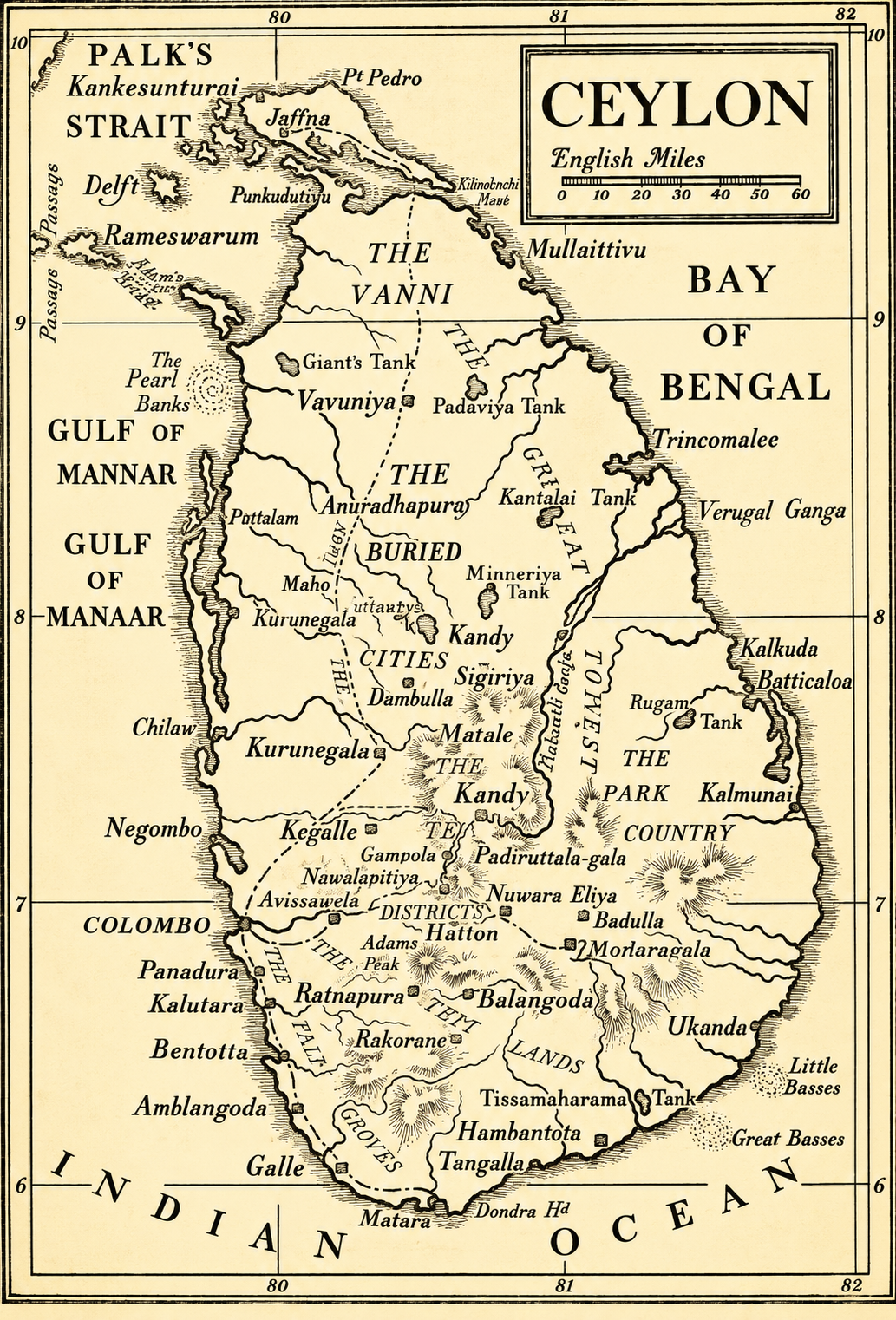
The island covers about 65,610 km². The administrative capital is Sri Jayawardenepura Kotte, while Colombo is the principal commercial centre. The latest national census, conducted in 2024, recorded a population of 21,781,800.
Economic figures are for 2025, the latest full-year figures published by the Central Bank as of 2026. Population and religion figures use the 2024 Census.
Sri Lanka is home to mountains and highlands, tropical rainforests, dry-zone forests, rivers and waterfalls, ancient reservoirs, tea plantations, national parks, coral reefs, islands, fishing communities and a long coastline.
02 — A Country of Many Landscapes
Travel only a few hours and the environment can change dramatically. Coastal plains rise into cool mountain country. Tea plantations replace coconut palms. Mist replaces sunshine. Waterfalls appear between hills, and later the landscape changes again into forests, dry plains and ancient irrigation tanks.
03 — The Mountains & Tea Country
Sri Lanka's mountains may not be the highest in Asia, but they have character. Roads twist through green valleys. Clouds gather around ridges. Waterfalls fall from forested slopes. Tea plantations cover hillsides like enormous green carpets.

Tea transformed the central highlands during the colonial period and became an important part of Sri Lanka's identity and economy. For travellers, tea country means plantations, estate communities, railway lines, factories, mountain villages and the daily work behind Ceylon Tea.
04 — The Forests of Sri Lanka
Sri Lanka may be small, but its biodiversity is extraordinary. Sinharaja Forest Reserve is a UNESCO World Heritage property and one of the country's great remaining areas of primary tropical rainforest.

More than 60% of the tree species recorded there are endemic to Sri Lanka. The forest is also home to remarkable endemic birds, mammals, amphibians, reptiles and insects.
05 — Wilder Sri Lanka
National parks such as Yala, Udawalawe, Minneriya, Wilpattu, Wasgamuwa, Bundala and Kumana protect different habitats and wildlife experiences.

The island is famous for Asian elephants, leopards, sloth bears, crocodiles, deer, buffalo and an enormous variety of birds. Wildlife is never guaranteed: a safari is an encounter with a living ecosystem, not a performance.
06 — The Ocean Around the Island
Fishing, trade, migration, food and travel have all been shaped by the Indian Ocean. Sri Lanka's coast offers famous beaches, surf towns, fishing villages, coral reefs, lagoons, islands and emerging coastal destinations.
Hiriketiya is one example of a once-quieter surf cove that has grown rapidly into an emerging coastal destination. Pigeon Island offers a different experience: a protected marine national park off Nilaveli, known for snorkeling and coral-rich waters.
07 — Ancient Sri Lanka
Sri Lanka's history stretches back more than two thousand years. Ancient kingdoms built cities, monasteries, irrigation systems, stupas and reservoirs.
Anuradhapura, Polonnaruwa, Sigiriya, Dambulla, Kandy and Galle each reveal a different chapter of the island's history.
08 — Eight UNESCO World Heritage Sites
As of 2026, Sri Lanka has eight UNESCO World Heritage properties: six cultural and two natural.
09 — Buddhism: A Living Tradition
Buddhism is not simply something Sri Lanka keeps in museums. It is part of everyday life. The 2024 Census recorded 69.8% of the population as Buddhist, alongside Hindu, Muslim and Christian communities.
Sri Lankan Buddhism is predominantly Theravada Buddhism. According to Sri Lankan historical tradition, Buddhism became established on the island in the 3rd century BCE, associated particularly with Arahat Mahinda Thera during the reign of King Devanampiya Tissa.

Mihintale is traditionally regarded as the place where King Devanampiya Tissa met Arahat Mahinda Thera. In Anuradhapura, the Sri Maha Bodhi remains one of the island's most revered Buddhist sites.
Across Sri Lanka, stupas, Bodhi trees, image houses, ancient monasteries and village temples continue to form part of the living landscape.
10 — Sri Pada / Adam's Peak
High above the surrounding landscape stands Sri Pada, also known as Adam's Peak. The mountain is sacred to several religious traditions. For Buddhists, the summit is associated with the sacred footprint of the Buddha; other faith traditions also have their own interpretations.
During pilgrimage season, thousands of people make the climb, often during the night, hoping to reach the summit around sunrise.
11 — Buddhist Festivals
Vesak and Poson are among the most important Buddhist celebrations in Sri Lanka. Lanterns, temple visits, offerings and community traditions fill towns and villages.

The Kandy Esala Perahera combines Buddhist religious tradition, ceremonial processions, dancers, drummers and traditional performers. For visitors it can be spectacular, but it remains fundamentally a religious and cultural event.
12 — Other Religions of Sri Lanka
Sri Lanka's identity is not defined by one religion alone. Hindu temples, mosques, churches and Buddhist temples exist throughout the island. Different communities have contributed to the island's history, food, languages and traditions.
13 — Languages of the Island
Sinhala and Tamil are the two official languages. English functions as a link language and is widely used in tourism, business and communication.
14 — People & Hospitality
Sri Lanka's greatest attraction may not be something you can photograph. It is the people. A cup of tea, directions from a stranger, food shared at a family table or a conversation with a shopkeeper can become part of a traveller's memory.
15 — Sri Lankan Food
Rice and curry can be an entire table: dhal, sambols, vegetables, fish or meat, jackfruit and seasonal dishes. Hoppers, string hoppers, kottu, roti and pittu add other dimensions to Sri Lankan food culture.
16 — Ceylon Tea
The name Ceylon Tea remains recognised around the world. Different elevations produce different characteristics, while the tea estates are also home to communities whose history is deeply connected with the plantation economy.
17 — Festivals & Traditions
Sinhala & Tamil New Year, Vesak, Poson, Kandy Esala Perahera, Deepavali, Thai Pongal, Ramadan and Eid celebrations, Christmas and countless local festivals create an island calendar full of colour and meaning.
18 — National Symbols
The Blue Water Lily is the national flower, the Na tree (Ironwood) the national tree, and the Sri Lanka Junglefowl the national bird. The national flag carries layers of historical and cultural symbolism.
19 — Climate & Monsoons
Sri Lanka is tropical, but its two monsoon systems mean different parts of the island can experience different weather at the same time. This makes regional planning more useful than a single “best month for Sri Lanka.”
20 — Travelling Respectfully
At temples and religious places, dress modestly, cover shoulders and knees where required, remove footwear when requested, speak quietly, follow local instructions and never treat sacred statues as props.
Ask before taking close-up portraits of people, especially monks, children and worshippers. Photography rules vary by site.
21 — Road, Rail & Trail
Private road travel offers flexibility. Train travel reveals the changing landscape of the highlands. Hiking reveals another Sri Lanka through mountains, tea estates, villages, forests and waterfalls.
22 — Sri Lanka for Hikers
Knuckles, the Pekoe Trail, Adam's Peak, Ella, Horton Plains, Sinharaja and countless local trails offer different levels of challenge. Weather, terrain, heat, leeches and remoteness should always be considered.
23 — Sri Lanka for Wildlife Lovers
Search for elephants in Udawalawe, leopards in Yala, seasonal gatherings around Minneriya, endemic species in Sinharaja or birds in wetlands and national parks. There is no single Sri Lankan wildlife experience.
24 — Sri Lanka for Beach Lovers
The beaches are not all the same. Some are famous for surfing, some for coral reefs, some for long quiet sands and others for emerging coastal culture. KANRA's Unlock Sri Lanka's Hidden Beaches collection will continue adding places worth discovering.
25 — Sri Lanka for Slow Travellers
You do not have to rush around Sri Lanka. Drink tea. Walk through a village. Watch the rain. Take the train. Sit beside a lake. Talk to a local family. Spend an afternoon doing almost nothing.
26 — The Spiritual Side of Sri Lanka
For some people, it is the atmosphere of an ancient temple. For others, it is walking beneath a Bodhi tree, listening to a rainforest stream or watching a mountain sunrise.
People sometimes describe certain places as having a cleansing or grounding atmosphere, or as helping them release emotional heaviness or “negative energy.” These are personal and spiritual experiences, not scientific claims.
27 — Responsible Travel
Forests need protection. Wildlife needs space. Coral reefs are fragile. Villages need respect. Trails need responsible visitors.
Carry waste out, avoid feeding wildlife, never chase wild animals, stay on appropriate trails, respect communities and follow park and guide instructions.
28 — What Makes Sri Lanka Different?
Maybe it is the size. A traveller can experience mountains, rainforest, wildlife, ancient heritage and beaches without crossing international borders.
Maybe it is the biodiversity. Maybe it is the history. Maybe it is Buddhism. Maybe it is the food, tea or people.
29 — KANRA's Sri Lanka
At KANRA, we don't want to show Sri Lanka only through the famous places. We want to go further — to forest trails, mountain paths, small villages, emerging beaches, tea estates, wildlife, ancient places and local stories.
Some journeys will be comfortable. Some will be challenging. Some will take you somewhere famous. Others may take you somewhere you have never heard of.
One Island. Many Worlds.
Sri Lanka is not an island you finish seeing in a few days. It is an island you keep discovering.
Welcome to Sri Lanka.
KANRA SL — Real Journeys. Local Stories. Wild Sri Lanka.